CEO turnover has become a recurring headline. But headlines may sometimes miss the point, at least from our point of view from the Board and Governance perspective. The real issue may not just be that more CEOs are leaving. It is whether boards, leadership teams, and organizations are structurally prepared for leadership volatility as a normal operating condition.
The latest Global CEO Turnover Index, from Russel Reynolds, shows 2025 closing at a record level of CEO departures globally—234 exits, up from 202 the year before. Yet focusing on the headline number risks missing what truly matters for governance, culture, and growth.
Because turnover is not the story. Governance capacity is.
In an interview with Wassim Karkabi our Founder & Executive Chair at our own Global Board Institute and Managing Partner / Shareholder at Stanton Chase, here is what we unearthed together.
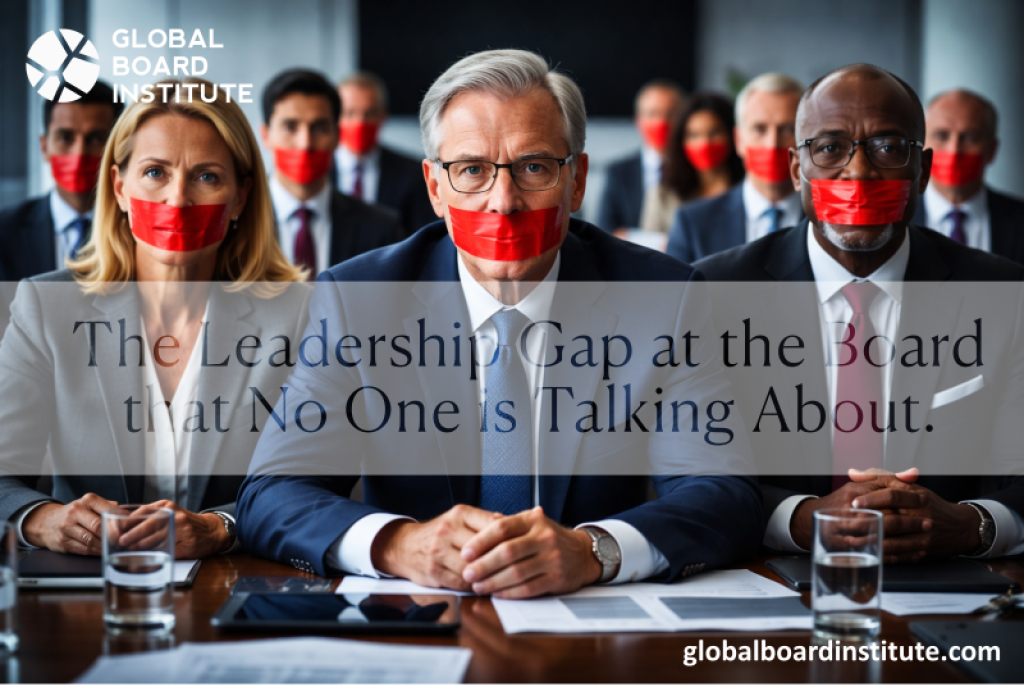
>> There is a Leadership Gap No One Is Talking About
In the final quarter of 2025, there were materially more CEO departures than appointments. In other words, exits were happening faster than replacements were being installed. That gap may appear administrative. It is not. When departures outpace appointments, organizations enter a period of structural drift. This may mean that strategy pauses, capital allocation decisions slow down, and top talent hesitates.
Boards spend disproportionate time on succession mechanics instead of enterprise risk and long-term value creation. This is what we call succession latency, the time between leadership exit and full strategic stabilization. In a volatile environment, the board’s competitive advantage is not avoiding turnover, but reducing latency.
So, the governance question shifts from “How do we prevent CEO exits?” to “How fast can we restore clarity, continuity, and confidence when they happen?”.
>> The Outsider Illusion
One of the most revealing patterns in the data is the sharp increase in external CEO appointments toward the end of 2025. Nearly half of incoming CEOs in the final quarter were external hires. On the surface, that suggests boards are looking outside for experience. But here is the twist: the overwhelming majority of newly appointed CEOs in 2025 were first-time CEOs. This means boards are not simply importing seasoned leaders from other enterprises. They are appointing leaders who are new to the CEO role, many of them from outside the organization.
"That is a materially different governance risk profile. A first-time CEO does not fail because of intelligence or capability. They fail when decision rights are unclear, the top team is misaligned and Cultural signals are inconsistent, and the board’s expectations are implicit rather than explicit. This is my concern here", said Wassim Karkabi, Founder & Executive Chair at Global Board Institute and Managing Partner / Shareholder at Stanton Chase.
The data suggests that CEO selection is no longer the most fragile part of succession, but integration may be. Boards that still treat onboarding as a ceremonial exercise are misreading the moment.
>> Sector Pressure Is Uneven, and That Matters
The increase in CEO departures in 2025 was not evenly distributed across industries. Industrial companies saw the sharpest rise in exits. Consumer-facing sectors also experienced significant acceleration. Healthcare departures increased from a low base. Meanwhile, technology—often perceived as the epicenter of leadership volatility, actually saw a decline in CEO exits compared to the prior year.
This divergence tells us something critical. Leadership turnover is not purely about market instability. It is often about operating complexity under transformation pressure. Industrial and consumer companies are navigating margin compression, portfolio reshaping, supply chain recalibration, as well as brand and stakeholder scrutiny. Boards in these sectors should be demanding reinvention at scale.
By contrast, sectors such as financial services and healthcare continue to show significantly longer average tenures—often double those seen in consumer and technology businesses. Regulation, capital intensity, and stakeholder ecosystems demand continuity.
This creates two distinct governance clocks, and boards that apply a single performance lens across sectors will misdiagnose both risk and opportunity.
>> Tenure Compression and the Culture Risk
In faster-cycle industries, outgoing CEO tenure is now often in the four-to-five-year range. That is barely enough time to implement a strategic pivot before pressure resets the clock.
Here is the hidden risk: culture fragmentation.
"Every new CEO brings with them language shifts, priority shifts, talent reshuffles, and incentive redesigns to name a few. If this cycle repeats too frequently, organizations will experience initiative fatigue. Employees stop committing deeply because “this will change again" and so culture becomes episodic rather than enduring", said Karkabi.
Our conclusion on this front is that boards have to therefore elevate culture from a “soft” metric to a governance asset. The question is no longer “Does this CEO fit the culture?” but rather “Can the culture survive leadership transitions without losing its identity?”.
The companies that outperform through volatility are those where purpose is board-protected, values are operationalized, and leadership behaviors are codified beyond personality.
That requires deliberate corporate governance design.
>> Diversity as a Governance Stress Test
The data also reveals that progress in CEO gender representation remains uneven. While there were meaningful appointments of women CEOs in 2025, the total proportion remains under 10% globally and in certain sectors, the numbers declined substantially compared to the prior year.
This is not merely a representation issue. It is a pipeline resilience issue. When turnover rises, boards under time pressure tend to revert to familiar archetypes. If diverse candidates are not deeply embedded in succession plans well before a vacancy arises, they disappear from consideration when urgency spikes.
High-turnover environments expose the strength or weakness of succession architecture. Boards that treat diversity as a communications objective will stall. Boards that treat it as a structural succession requirement will compound advantage over time.

>> Growth Under Volatility: The Compounding Problem
Frequent CEO turnover disrupts growth in three predictable ways
- Strategy resets before compounding: Long-cycle investments such as digital transformation, market expansion and capability building require multi-year continuity.
- Top-team instability increases execution risk: New CEOs often reshape their executive teams. When this occurs repeatedly, execution discipline suffers.
- Risk appetite oscillates: Each leadership transition recalibrates the organization’s tolerance for risk, creating inconsistency in capital deployment.
The data suggests that CEO turnover is no longer episodic. It is cyclical. Therefore, boards must decouple growth from personality and growth strategy should be institutionalized, not individualized. It should tracked through multi-year scorecards, and anchored by clearly defined strategic invariants. Without this discipline, volatility erodes long-term value creation.
>> The Governance Operating System for a High-Turnover Era
If CEO volatility is here to stay, governance must evolve accordingly. Here are five structural shifts boards should implement immediately:
- Treat Succession as a Standing Agenda Item - Not quarterly. Not annually. Ongoing. Include emergency coverage, readiness depth, and external market mapping.
- Define Strategic Invariants - Clarify what will not change for 24–36 months, regardless of CEO transition. Protect those pillars from reinvention fatigue.
- Formalize CEO Onboarding - For first-time CEOs especially, the first 180 days are governance-critical.
Boards should agree upfront on decision-right clarity, Top-team stabilization milestones, and culture preservation priorities. - Separate Performance from Transformation - Short-tenure sectors require a trajectory lens that includes momentum, speed, and execution capability. Long-tenure sectors require durability—risk management, trust capital, and compounding value.
- Protect Cultural Coherence - Purpose and values should not reset with each CEO. The board must be the steward of cultural continuity.
For CEOs and the C-Suite, continuity should be the Leadership Edge. In volatile governance environments, CEOs and executives who succeed do three things differently.
- They clarify decision rights immediately.
- They stabilize the leadership team before pursuing aggressive transformation.
- They institutionalize cadence (weekly, monthly, quarterly) rhythms that outlast personality.
The C-suite must also evolve. Executives who operate as siloed function heads amplify transition risk. Those who act as a cohesive enterprise leadership team become the stabilizing force boards rely upon.
The Bottom Line is that leadership volatility is becoming normalized across major indices and industries. Boards are increasingly appointing first-time CEOs, often from outside the organization. Sector-specific pressures are compressing tenure in some industries while preserving longevity in others.
The question for every board is simple. Is your governance model designed for stability in stable times—or resilience in volatile ones?
Organizations that master succession latency, protect cultural coherence, and institutionalize growth strategy will outperform, not because they avoid turnover, but because they metabolize it.
In the coming decade, the differentiator will not be charismatic leadership. It will be governance systems capable of sustaining performance when leadership inevitably changes, and that is where true board leadership begins.