Stop rebuilding your committee charters from scratch every year.
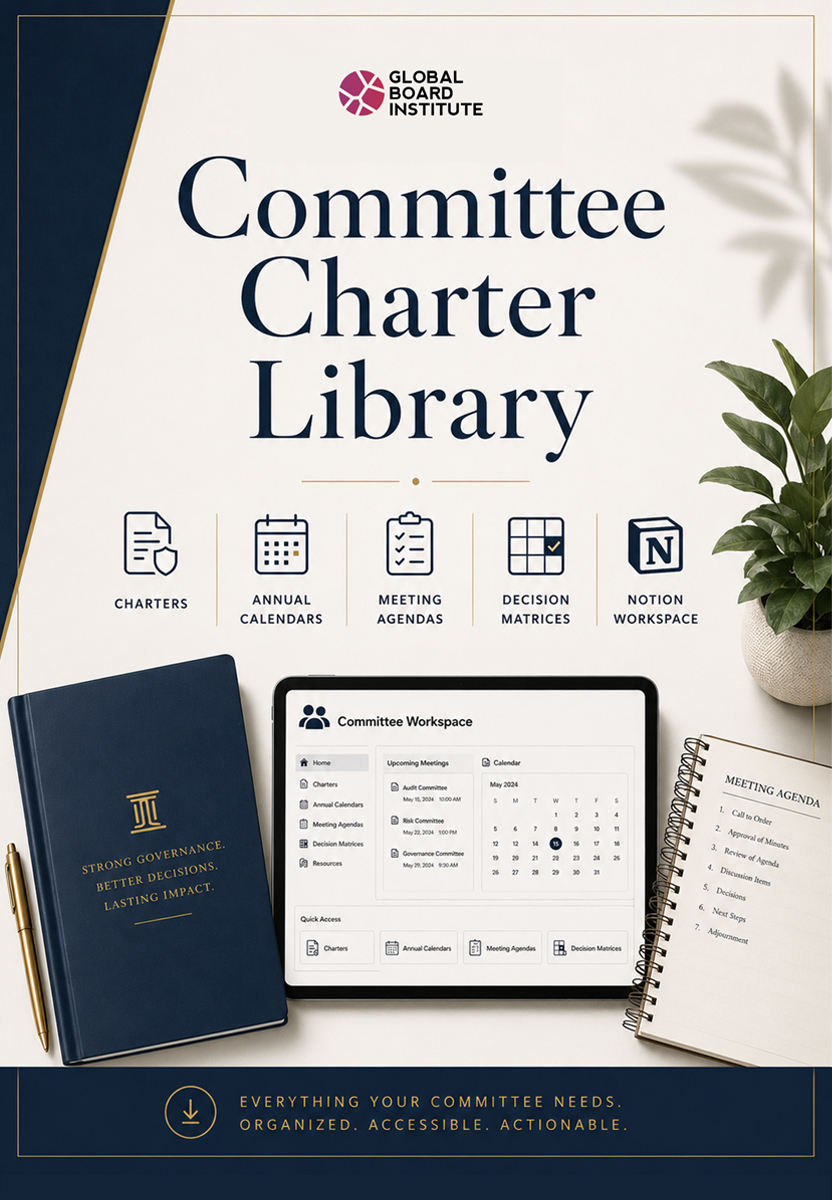
Four ready-to-adopt committee charters — Audit, Compensation, Nominating & Governance, and Risk — with annual calendars, sample agendas, 60 mapped board decisions, and a Notion workspace you can paste in this afternoon.
30-day refund. No questions, no friction. Updated for 2026 SEC and exchange rules.
If you run a board, you've lived this.
Charter season comes around. Last year's Word doc is somewhere on the shared drive. The Audit chair wants the cyber language updated. The Compensation chair just got a Glass Lewis ding. NomGov hasn't done a real composition matrix in three years. Nobody can find the charter change log. And the AGM is in eleven weeks.
- Charters that haven't kept up with the rules. SEC cyber-disclosure, clawback, pay-vs-performance — and your charters still reference 162(m).
- A calendar that lives in someone's head. The CFO knows it. The GC half-knows it. The new corporate secretary is rebuilding it from email threads.
- "Whose call is this?" arguments mid-meeting. Should the full board approve this severance? The earnings release? The internal-audit hire? Charters are silent.
- Outside counsel quotes you $18,000 to refresh four charters. Or $40,000 if you want them to redo the calendars and decision matrices too.
- You inherit a binder, not a system. The charters open in Word. The minutes are in BoardEffect. The risk register is on someone's laptop. None of it talks to each other.
One toolkit. The full committee year. No subscription.
The Committee Charter Library is the working manual most corporate secretaries already have pieces of — the charters, the calendars, the matrices — but never get to assemble in one place. We assembled it. You adopt it.
Open the Word charters and customize 18 highlighted blocks (we tell you which ones, and the language to use). Drop the calendars on the Audit, Comp, NomGov, and Risk chairs. Print the 60-decision matrix and tape it inside your binder. Paste the Notion map into your governance workspace and run the year out of one searchable surface.
Charter Architecture
The seven sections every charter needs and the four mistakes that fail audit-firm review.
- The seven-section structure for any charter — current and future committees
- Why "monitors" vs. "oversees management's monitoring of" matters under Caremark
- The exact Authority & Resources language NYSE 303A.07(c)(iii) requires
Charter · 12-month calendar · Q4 agenda · Decision matrix · Independence checklists
A complete Audit Committee operating package, NYSE/Nasdaq + Rule 10A-3 aligned.
- Full charter with Independent Auditor, ICFR, whistleblower, and risk language
- 12-month calendar mapped to a December year-end (adjust ±3 for non-calendar fiscal years)
- Sample year-end audit meeting agenda with executive sessions and time blocks
- 13-decision matrix from auditor appointment to restatement
- Annual independence + financial-expert checklists
Charter · Calendar · Year-end agenda · 14-decision matrix · Consultant independence
Built for boards living with Pay-vs-Performance, clawback, and a tougher say-on-pay environment.
- Full charter aligned to NYSE §303A.05 / Nasdaq Rule 5605(d), Rule 16b-3, and Rule 10C-1
- Year-round calendar tied to fiscal close and proxy season
- Year-end CEO/NEO decision agenda with executive-session structure
- Six-factor compensation consultant independence checklist (Rule 10C-1)
Charter · Calendar · Self-assessment · Board composition matrix · 10-decision matrix
The committee that owns slate, succession, and the board's own performance — given a real toolkit.
- Charter covering nomination, evaluation, succession, and ESG allocation
- Annual calendar aligned to evaluation, recruiting, and pre-AGM cycles
- Director self-assessment template (board, committee, individual)
- Eleven-attribute board composition matrix that surfaces real skill gaps
Two versions: Standalone Committee + Audit-Subcommittee · Risk appetite + register
Risk oversight that survives a SEC cyber rule, a TCFD reporting question, and a real incident.
- Standalone Risk Committee charter and drop-in language for boards using Audit as the risk overseer
- Quarterly calendar with cyber, third-party, and climate cadence
- Six-line risk appetite statement template (with quantitative limits)
- Sample top-15 enterprise risk register with movement indicators
All four committees + the full board on one page.
The artifact most companies never assemble, given to you on day one.
- Week-by-week calendar from January through December
- Joint sessions visible (Audit+Risk; Comp+Risk; Audit+NomGov; Comp+NomGov)
- Maps every committee meeting to the board meeting it feeds
60 recurring board-level decisions. Mapped to who owns each.
The single most useful page in the library. Settles arguments before they start.
- From "Auditor appointment" to "Sustainability report" — every standing decision
- Approve / Recommend / Informed columns for each committee + Board + Mgmt
- Cross-referenced to the relevant section of each charter
The four-step process the General Counsel runs every May.
So the annual review actually happens annually.
- Authority refresh: NYSE/Nasdaq, SEC, DGCL, ISS/Glass Lewis
- Gap analysis against actual practice (the part most reviews skip)
- Committee redline → board approval → public posting → change log
The 18 places most charters need adjusting — and the language to use.
Listing standard, comp committee independence, overboarding policy, ESG allocation, and 14 more.
Run the entire committee year out of one searchable Notion surface.
Page tree, three database schemas (meetings, decisions, action items), and instructions to wire it up in an afternoon.
Corporate secretaries and GCs who used it last quarter.
I inherited the corporate secretary role at our holding company in November. By January I had four committee charters, a consolidated calendar, and a decision matrix on the wall behind my desk. My GC's exact words after the February audit committee meeting: "this is the cleanest year-end I've worked." The library paid for itself in the first week.
Our outside counsel quoted $22K to refresh the four charters and rebuild the calendar. I bought this for $397, did the customization in four hours, and sent the redline to counsel for the final review. They billed two hours of partner time. The board approved them at the May meeting with no comments.
I've sat on five public-company boards over fifteen years. The 60-decision matrix is the artifact every chair wishes someone would build, and nobody ever does. We adopted it as the official "RACI" for our governance binder. It has eliminated three or four "should the board approve this?" debates per year.
Two weeks from now.
Same role, same board, same calendar — different posture.
Before the library
- Last year's charters live in three different versions across SharePoint, BoardEffect, and someone's email.
- The annual review is "on the list" for the third year running.
- Nobody has a single document showing all four committees' meeting weeks at once.
- "Should the comp committee approve this severance package?" is debated for 12 minutes mid-meeting.
- Outside counsel reviews charters at $850/hour, billable to your committee budget.
- The new director onboarding pack is "let me dig that up."
Two weeks after adoption
- Four charters approved, posted publicly, and tracked in a change log.
- One consolidated annual calendar pinned to the corporate secretary's office.
- A laminated 60-decision matrix on the wall of every committee chair's office.
- Decision questions answered in 20 seconds by checking the matrix.
- Outside counsel does a 2-hour final-pass review instead of a 25-hour rebuild.
- New directors receive the entire library on day one and read it cover to cover.
A working tool. Not a $40,000 consulting engagement.
One-time purchase. Lifetime updates for the year. No subscription.
The Complete Committee Charter Library
For multi-entity GCs and PE portfolio teams who manage governance across boards.
Standalone value $2,400+
- Everything in Library
- Pre-built Notion workspace (importable .json)
- Director onboarding pack template
- Priority email support, 12 months
- All 2026 + 2027 updates
NO-RISK
If it doesn't earn its price back the first time you use it, you don't pay.
If 30 days from purchase the library hasn't already saved you more than $397 in counsel fees, paralegal time, or board-meeting hours, email hello@globalboardinstitute.com and we will refund the entire purchase. No screenshots required. No interrogation. We trust corporate secretaries to know whether something is working.
Honest answers to the questions you'd ask outside counsel.
Is this legal advice?
No. The library is a lawyer-built starting point — not legal advice. Every charter and policy should get a final review from your General Counsel or outside counsel before adoption. The library is designed to make that final review take an afternoon instead of a quarter. Most users send the customized charters to counsel for a 2–4 hour final pass.
Will this work for a private company or a pre-IPO board?
Yes — and we built it specifically with pre-IPO and private-company governance in mind. Private companies don't need a 10-K, but the same charter discipline (committee independence where appropriate, decision rights, executive sessions, calendar cadence) is exactly what investors, future underwriters, and acquirers will look for. The customization guide flags which sections are listing-standard-specific and what to drop or modify.
How current are the SEC and listing-standard references?
Current through the start of 2026. The library cites NYSE 303A, Nasdaq 5605, SEC Rules 10A-3 and 10C-1, Reg S-K Items 402 and 407, SOX §404, Dodd-Frank §954, PCAOB AS 1301, and DGCL §141. Buyers of the Library and Boardroom tiers receive the 2026 mid-year update at no charge.
What format does it ship in?
Three formats, your choice. Microsoft Word documents (one per charter, ready to redline). Beautifully designed HTML files (read in browser or print to PDF). Markdown source (for Notion, GitHub, or any wiki). All three are included.
Can I share this with my board members and our outside counsel?
Yes. Single-entity tiers (Essentials, Library) are licensed for use by a single company — meaning all of your directors, your management team, and your outside counsel for that company can read and work with it. The Boardroom tier extends this license across up to five portfolio or affiliated entities.
How is this different from BoardEffect, Diligent, or similar platforms?
Those are software platforms for distributing meeting materials and capturing minutes. The Committee Charter Library is the substantive content — the charters, calendars, agendas, and decision rights — that runs on top of any of those platforms (or in Notion, or on paper). They're complementary. We tell you exactly how to wire the library into BoardEffect, Diligent, or Notion.
Why is this so much cheaper than what outside counsel would charge?
Because we wrote it once. Outside counsel rewrites it for every client, with the same Reg S-K cite checks and the same NYSE / Nasdaq research. Counsel is invaluable for the customization and the final review. Counsel is overpriced as the rough drafter. We did the rough drafting. Counsel does the customization and the sign-off.
What if my board uses a different fiscal year?
The calendars are mapped to a December 31 year-end (the most common). The library includes a one-page guide showing how to shift each calendar by ±3 months for fiscal years ending in March, June, or September. Most users do this in 20 minutes.
Ship a defensible committee year.
The library is $397 once. Most buyers report it pays back in the first week — through saved counsel hours, faster meetings, or a single avoided "should the board approve this?" detour.
Get the Committee Charter Library30-day refund · Updated for 2026 · Word + HTML + Notion