For Board Chairs, NRC Chairs and the people who support them

Five Pillars of NRC Governance™

A working framework for the committee that carries the board's decisions about people.

Created by Wassim Karkabi, Founder and Executive Chairman, Global Board Institute.

  1. 1Nomination
  2. 2Remuneration
  3. 3Succession
  4. 4Evaluation
  5. 5Development

The committee that carries the most, often with the least support

The Nomination and Remuneration Committee holds the board's decisions on people. It decides who joins the board and who runs the company. It decides what they are paid and what that pay rewards. It plans who comes next, judges how well they perform, and makes sure directors keep up with what the board now has to oversee.

In our view it is often the least equipped committee on the board. Many NRCs meet when a seat falls vacant or the pay round comes up. They work from a charter written for another company, and they treat each of their jobs as a separate task.

When those jobs are handled apart, they pull against each other. A director is appointed with no reference to the succession plan. A pay award goes through with no honest evaluation behind it. Development is the first budget line to be cut.

The Five Pillars of NRC Governance treat the committee's work as one set of connected decisions. Each pillar has decisions the board can see and questions the committee should be able to answer.

The five pillars

Each pillar is a set of decisions the NRC owns, and each one feeds the others. An evaluation finding changes a nomination priority. A gap in the succession plan changes the development plan. A pay decision shows the whole company what the board rewards.

Pillar one

Nomination

Who enters the boardroom.

What it decides: the skills and experience the board needs, who is put forward for a seat, and who fills the most senior executive roles.

Questions a board should be able to answer:

  • Does our skills matrix drive our nomination decisions, or describe them after the fact?
  • When did we last appoint a director who was not already known to someone on the board?
  • What will the board need in three to five years, and who is in the pipeline for it?

Pillar two

Remuneration

What leaders are incentivised to do.

What it decides: the pay policy for the CEO, executive directors and senior executives, the measures behind variable pay, and the fees paid to non-executive directors.

Questions a board should be able to answer:

  • Could we explain the CEO's total pay, and the reason for it, to a sceptical investor in fifteen minutes?
  • Does our pay structure reward the behaviour we want, over the time that matters?
  • Would our pay decisions stand up to a shareholder vote?
Pillar three

Succession

Who will lead tomorrow.

What it decides: the plan for the CEO's planned and sudden departure, the rotation of directors, and the succession of the Chair.

Questions a board should be able to answer:

  • If our CEO could not serve tomorrow, who would step in, and are they ready?
  • Does our plan reach beyond the current CEO's expected tenure?
  • Does our board renewal plan follow the strategy, or only the calendar?
Pillar four

Evaluation

How performance is held to account.

What it decides: how the board, its committees, the Chair, each director and the CEO are assessed, by whom, and what happens to the findings.

Questions a board should be able to answer:

  • Did our last board evaluation change anything?
  • Do directors receive candid, specific feedback on their own contribution?
  • Is the CEO assessed against objectives the board agreed in advance?
Pillar five

Development

Whether directors are equipped to govern.

What it decides: what the board needs to learn, how the gaps are found, and the programme that closes them, from induction onwards.

Questions a board should be able to answer:

  • Has the NRC tested what the board knows against what it will have to oversee in the next three years, such as AI, cybersecurity and sustainability reporting?
  • Does the NRC own a development programme, or is learning left to each director?
  • Do new directors receive a structured induction before they are expected to contribute?

How we work with your NRC

GBI works with the NRC across all five pillars. Some boards ask for one piece of work. Others ask us to build the committee's work from the start. Every engagement is scoped to your board. The map below shows everything we can take on, in four groups.

Foundations

Set the committee up to do its job.

NRC terms of reference and charter

What the board gets: a charter that sets the committee's mandate across all five pillars, its membership, its authority and how it reports to the board.

Committee composition and the skills matrix

What the board gets: the right mix of members on the committee, and a board skills matrix tied to strategy and used to make decisions.

The annual NRC calendar and agenda design

What the board gets: a twelve-month calendar that puts each pillar on the agenda at the right point in the year, with agendas built around the decisions in front of the committee.

People

Put the right people in the room.

Hiring the NRC Chair

What the board gets: a written role specification, a search inside and outside the board, and an assessment of each candidate against what the committee needs from its Chair.

Appointing committee members

What the board gets: clear criteria for who sits on the NRC, covering independence, skills and time, and help choosing members from the board or from outside it.

Board and director search

What the board gets: independent directors, chairs and committee chairs, found against a written specification, across the GCC and internationally.

Senior executive appointments

What the board gets: support for the committee's part in CEO and senior executive appointments, from the specification and the assessment criteria to the committee's recommendation to the board.

Programmes

Build the work the committee runs every year.

Succession, for the CEO and the board

What the board gets: a CEO succession plan that covers both planned and sudden departures, and a board renewal plan tied to strategy and tenure.

Remuneration framework and pay policy

What the board gets: a pay policy for the CEO and senior executives that the committee can explain and defend, and a fee structure for the board's own directors.

Board and CEO evaluation

What the board gets: evaluation of the board, its committees and each director, from a guided self-assessment to a facilitated external review, and a CEO evaluation set against objectives agreed in advance.

Director development and onboarding

What the board gets: development programmes built from your evaluation findings and your strategy, and a structured induction for every new director. For NRC Chairs and members who want a formal qualification, GBI also offers the Professional Diploma in NRC Governance.

Review

Test the committee you have.

NRC effectiveness review

What the board gets: an independent evaluation of how your existing NRC operates and how effective it is, pillar by pillar, with a written report and a plan to build stronger foundations.

One question rather than a project? Book a paid 45-minute advisory session with Wassim Karkabi. Book an advisory session

How an engagement runs

1

A conversation

You tell us what the committee is facing. We ask questions and tell you plainly whether we are the right people to help.

2

A scope and a fee proposal

We set out in writing what we will do, what you will receive, who will do the work and what it will cost. Nothing starts until you agree it.

3

The work

We work with the NRC Chair, the committee and the people who support it, such as the company secretary and the CHRO. The committee hears from us as the work goes on.

4

A report to the board, and follow-through

We report in writing to the committee and the board. Then we stay with you while the changes are put in place.

Who created the framework

Portrait of Wassim Karkabi, Founder and Executive Chairman of Global Board Institute.

Wassim Karkabi is Founder and Executive Chairman of Global Board Institute, and Managing Partner and Board Director at Stanton Chase, Middle East and Greater China. Wassim is also Non-Executive Chairman of Data Slot and of Spantrek, and a Non-Executive Director of Ekuiplus. Today Wassim serves as a Non-Executive Director and NRC Chair.

Wassim has spent more than twenty years in board and C-suite search. The record runs to around 1,900 board and C-suite search assignments for over 1,200 companies and boards, across the GCC, North Africa, the Levant, Asia, Europe, the Americas and South Africa. About one in five of those assignments is board advisory work: board evaluation, composition, compensation, governance and terms of reference design, and C-suite evaluations.

The five pillars come out of that work, seen from both sides of the table. One side is finding and assessing the people boards appoint. The other is sitting on the committee that appoints them.

The book

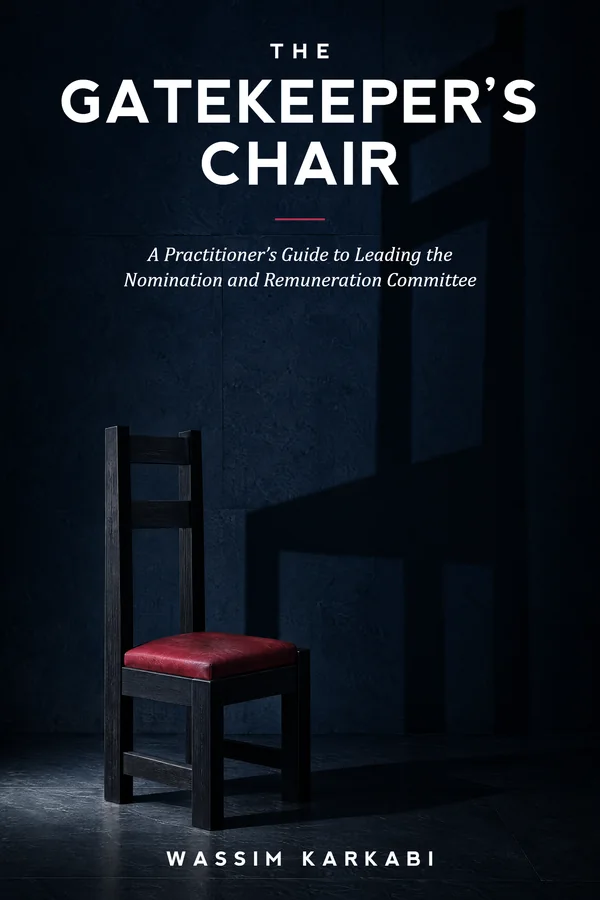
The Gatekeeper's Chair. Out in December.

A practitioner's guide to leading the Nomination and Remuneration Committee, by Wassim Karkabi.

One part for each of the five pillars, and a Toolkit of ten practical tools for the NRC Chair.

Discuss your NRC

Tell us what your committee is facing. We will reply by email to arrange a first conversation.

Please include your country code.

Every board decision about people passes through the NRC. Build the committee to carry them.